
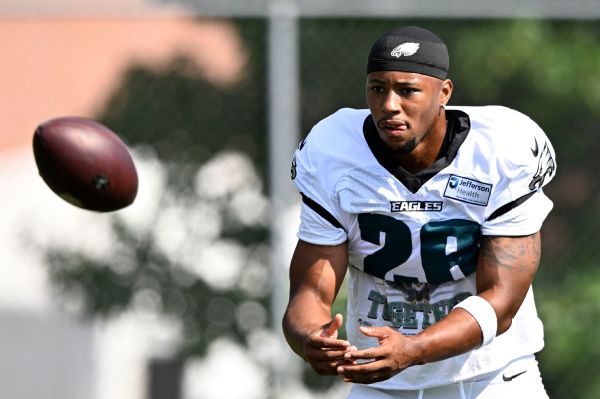
Nick Sirianni handed the offense over to Sean Mannion this offseason, and the install has been built around the exact complaint Barkley was making quietly all last year: put him under center, let him read linebackers and safeties before the snap instead of after it, and get back to outside zone with play-action off it. Barkley spent the offseason picking Todd Gurley's brain on how to read those zone-blocking lanes. The line in front of him turned over too. Mekhi Becton walked for a deal with the Chargers, and Lane Johnson, working his way back, has been telling anyone who'll listen this group can put the 2024 version of Barkley back on tape.

That version wins with patience, not just speed. Barkley presses the line of scrimmage, lets the zone blocks develop, and makes one decisive cut instead of dancing behind it, which is why he's always been more dangerous the moment he hits the second level than the moment he takes the handoff. He breaks arm tackles at the point of contact rather than after it, and he's still a legitimate receiving option out of the backfield, which keeps him on the field on third down instead of ceding those snaps to a passing-down back. Under center, with backside safeties frozen by play-action, that vision translates into the long, backbreaking runs that made 2024 look effortless.
The honest risk is that 2025 wasn't only a scheme problem. Barkley was getting hit well behind the line all year as the front got shuffled by injuries, and the explosive runs that defined 2024 nearly vanished — he turned only a handful of carries into 20-plus-yard gains last year against a flood of them the season before. A new playbook doesn't fix a line that can't hold up, and Becton's departure means at least one new face in that group again. Barkley is also carrying one of the heaviest workloads any back in the league has taken on in recent years, and history isn't kind to backs who get force-fed touches at his age.
The name worth measuring him against here is Derrick Henry. Henry is the same story told a season ahead of Barkley — a big, straight-line runner who was supposed to be cooked by now, and instead he's thriving behind Baltimore's outside-zone, play-action-heavy system with a line built to move people. If that scheme can keep extending a back deep into his thirties, there's no reason Mannion's version, installed for a back with better feet and a real receiving game, can't do the same for Barkley. Between the two, I'd rather have the one just getting handed the system that already worked for him once.