
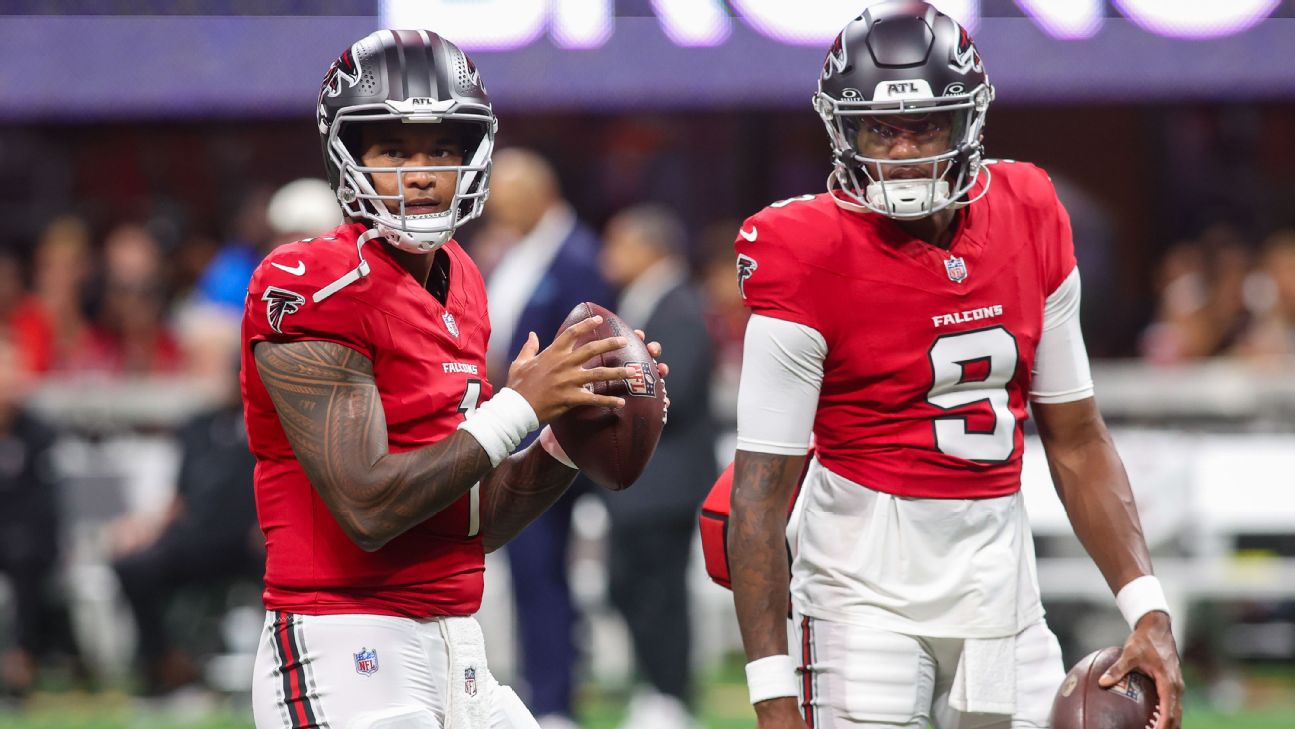
The Falcons didn't just re-sign London this offseason, they gutted the staff around him. Raheem Morris and OC Zac Robinson are gone, replaced by Kevin Stefanski and Tommy Rees, who bring a wide-zone, play-action-heavy system built in Cleveland and Minnesota. Robinson used London as a movable Z, sliding him into the slot as often as any receiver in the league. Stefanski's staff runs a scheme that wants bigger bodies on the perimeter who can block the edge, which points London back outside as a true X. It's the first real scheme change of his career, and it's happening the same offseason Atlanta handed him the richest deal in franchise history and locked him in as QB1's first read no matter who's throwing it.

London has never won with separation. He wins the way he says he tries to: modeling himself after Mike Evans and Calvin Johnson, receivers who beat you at the catch point instead of before it. He shields corners with his frame, high-points the ball in a crowd, and turns contested targets into first downs at a rate most receivers his size don't touch. That skill set doesn't care who's dialing up the plays or which gap he's lined up in — it travels. It's also exactly what a run-first, play-action offense wants from its outside receiver: someone who can win a jump ball off a boot leg without needing three steps of separation first.
The honest risk isn't talent, it's volume and health. A left knee PCL sprain knocked him out for a chunk of last season's back half, and he's never finished a full slate healthy in his career. Layer on a brand-new scheme that wants to run the ball and use two tight ends, and there's a real path where London's target share shrinks even if his per-target production stays elite. He's also never been a big after-the-catch threat — take away the volume and there isn't a highlight-reel gear underneath it to fall back on.
Justin Jefferson is the receiver London's new contract quietly passed on a per-year basis, and it's a useful frame because their games are opposites. Jefferson wins early, with footwork and burst that get him open before the ball's out. London wins late, at the catch point, against coverage that's already arrived. Jefferson's game is more explosive when the offense around him is humming; London's is more stable because it doesn't depend on scheme as much. Betting on London over Jefferson is a bet that a receiver who wins in phone booths is safer than one who needs a system to fully unlock him — and with Atlanta's staff turning over and Minnesota's more settled, that's not an unreasonable bet to make.